
The right foam for each surface
Spray Foam Insulation in Washington, DC
Air sealing and insulation in one layer, used where it earns its cost.
- Free on-site estimates
- Written quote listing material, thickness and R-value for every area
- Moisture and ventilation checked before anything is sealed up
Why Foam Suits Old DC Houses
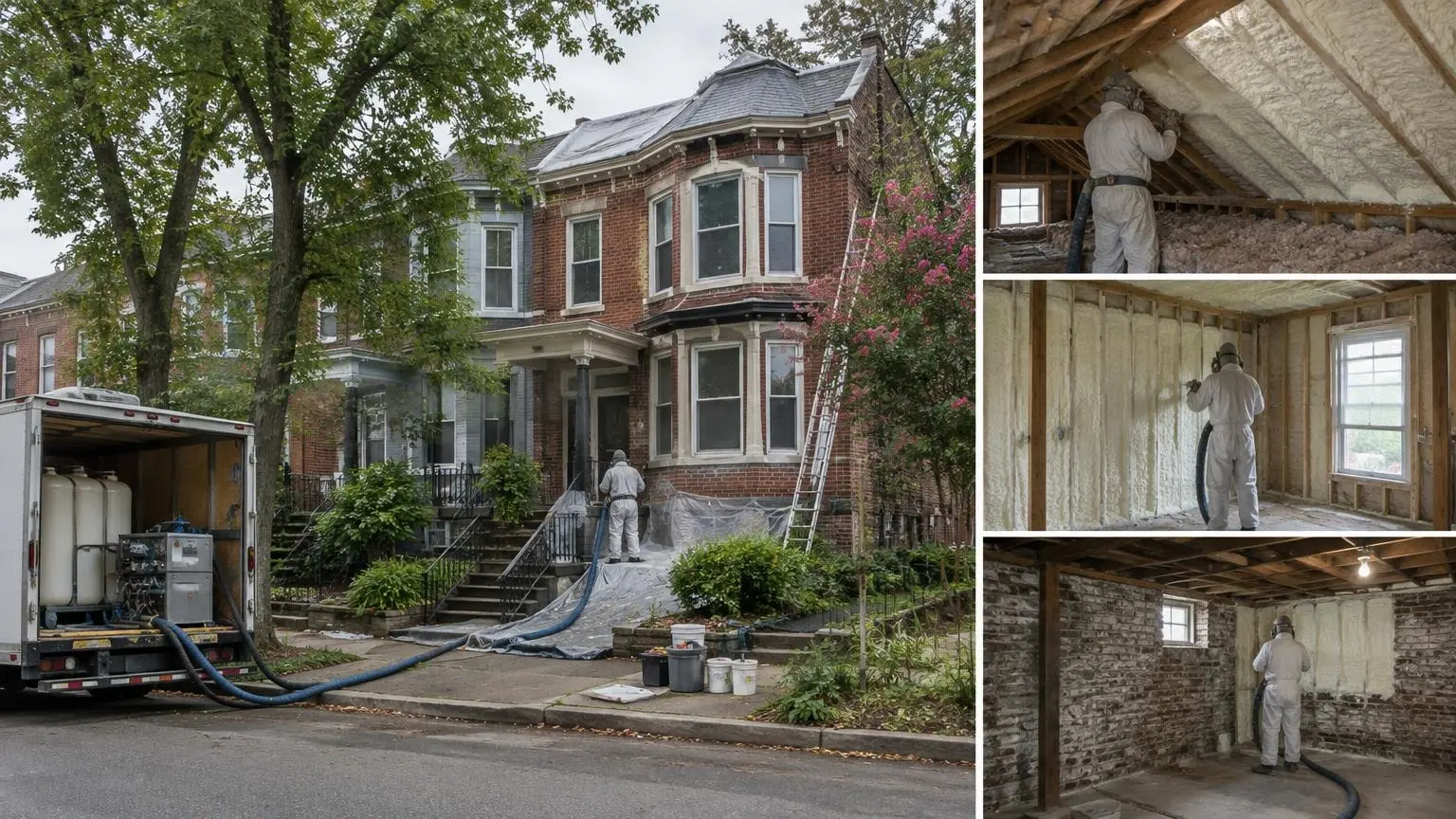
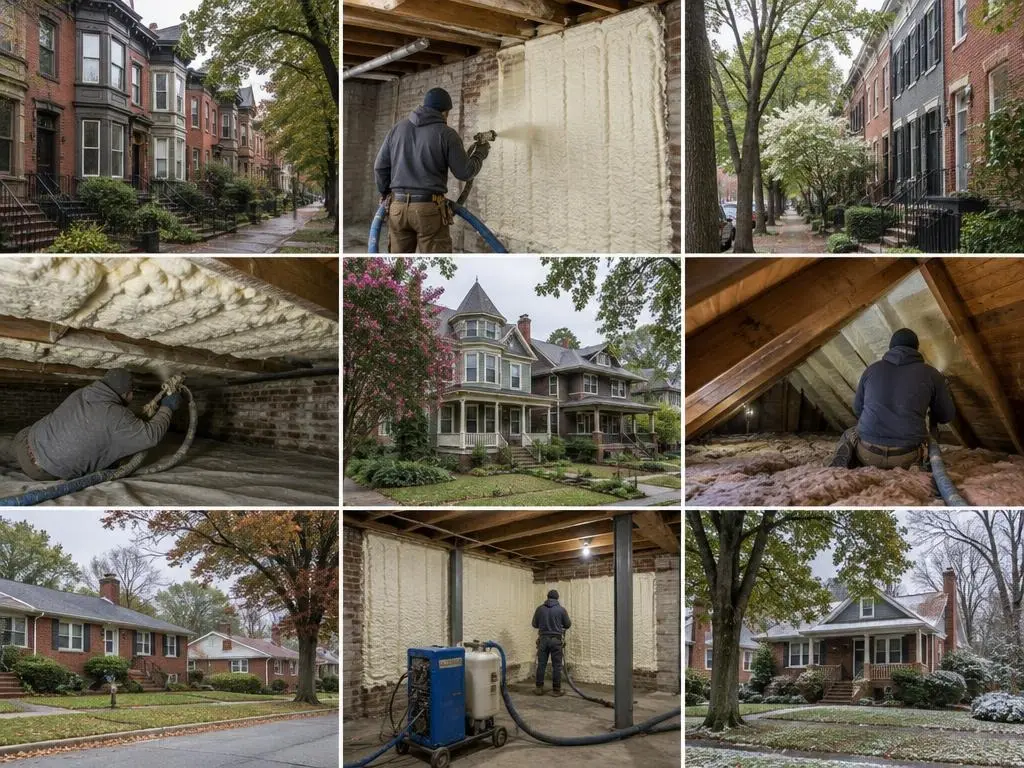
Spray foam insulation goes on as a liquid, expands and hardens in place, which lets it seal the cracks and odd shapes that old houses are full of. In a DC rowhouse that means the shallow space under a low-slope roof, the brick-and-joist pockets where floors meet party walls, the rim joist above the basement, and stud bays opened during a renovation. Foam seals and insulates those places at once, where batts would leave gaps.
Closed-cell foam
Dense and rigid, closed-cell foam rates about R-5 to R-7 per inch (HomeGuide) and slows water vapor at normal thickness. It is our choice for basement walls, crawl spaces, rim joists and shallow roof cavities where we need the most R-value in the least depth. HomeGuide lists it at $3.00 to $5.00 per square foot installed.
Open-cell foam
Open-cell foam is lighter, about R-3.5 to R-3.7 per inch, and $1.50 to $3.50 per square foot. It seals air very well and is often used on the underside of a roof deck to bring an attic inside the conditioned space, and in interior walls for sound. Because it lets vapor through, it needs the right details on a roof deck, and we do not use it against a cold or damp masonry wall.
When we recommend something else
On an open attic floor with room for depth, air sealing plus blown-in cellulose or fiberglass usually reaches a higher R-value for less money. We say so when that is the better choice.
Humidity and the building
DC's summers are humid. Sealing a house cuts the amount of damp outdoor air leaking in, which helps the air conditioner. But a tighter house also needs working bath and kitchen exhaust. We look at ventilation during the visit.
Curing
HomeGuide advises staying out for 24 hours or more while foam cures. We plan the schedule so you know when to leave and when you can come back.
Where We Use Foam
The places foam does a job other insulation cannot.
Roof cavities and roof decks
Foam under low-slope rowhouse roofs and on the underside of pitched roof decks.
Basement walls and rim joists
Closed-cell on brick, block and concrete foundations and the band joist above.
Crawl spaces
Closed-cell on crawl space walls with a sealed rim, under porches and additions.
Open walls in renovations
Foam in exposed stud bays during gut renovations and additions.
Bump-outs and rear additions
Floors and ceilings of rear additions and kitchen bump-outs, often the coldest rooms.
Published Spray Foam Insulation Costs
| Job | Range and source |
|---|---|
| Spray foam, installed | $1.50 to $5.00 per sq ft (HomeGuide) |
| Open-cell / closed-cell | $1.50 to $3.50 / $3.00 to $5.00 per sq ft (HomeGuide) |
| About 1,000 sq ft | $1,500 to $5,000 (HomeGuide); $3,150 to $7,500 existing home (Fixr) |
| Existing walls / new construction | $3.15 to $7.50 / $2.75 to $6.50 per sq ft (Fixr) |
| All exterior walls | $4,000 to $10,000 (HomeGuide) |
| Whole house | $8,000 to $20,000 (HomeGuide); $10,000 to $30,000 (Fixr) |
| Typical job minimum | $1,000 to $2,000+ (HomeGuide) |
National ranges from HomeGuide (2026) and Fixr (2025). Foam type, thickness, access and prep change the total, and small jobs often hit a minimum. The written estimate we give you after measuring is the price.
How a Foam Job Goes
1. Inspect
Check each space for moisture, leaks, wiring and ventilation, and measure.
2. Quote
Foam type, thickness, R-value and price for each area, in writing.
3. Prepare
Protect floors, finishes and belongings; set up ventilation and close off the area.
4. Spray
Apply in passes to the specified thickness.
5. Review
Ventilate during cure, clean up and walk through the work with you.
Why Choose Us for Spray Foam Insulation
Thickness in writing
You know the inches and R-value before work starts.
Moisture details
Foam type chosen with vapor movement in mind.
Honest about cost
If loose fill does the job for less, we say so.
Spray Foam Insulation Questions
Is closed cell or open cell better for a DC rowhouse roof?
It depends on depth and the roof assembly. In a shallow cavity, closed cell packs more R-value per inch. Under a pitched roof deck with more space, open cell can work with the right vapor details. We look at the roof before recommending either.
What is cheaper, spray foam or regular insulation?
Blown-in and batts cost less per square foot; HomeGuide lists blown-in at about $1.00 to $2.80 against $1.50 to $5.00 for foam. Foam also air seals, which is why it costs more.
How long do I need to stay out?
HomeGuide advises 24 hours or more while foam cures. We give you the timing for your job.
Does foam need to be covered?
Foam in living spaces generally needs a thermal barrier like drywall; attics and crawl spaces depend on use. We explain what applies before quoting.
Spray Foam Insulation Service Areas
- Spray Foam Insulation in Washington, DC
- Spray Foam Insulation in Capitol Hill, DC
- Spray Foam Insulation in Georgetown, DC
- Spray Foam Insulation in Petworth, DC
- Spray Foam Insulation in Silver Spring, MD
- Spray Foam Insulation in Takoma Park, MD
- Spray Foam Insulation in Bethesda, MD
- Spray Foam Insulation in Rockville, MD
- Spray Foam Insulation in Hyattsville, MD
- Spray Foam Insulation in College Park, MD
- Spray Foam Insulation in Bowie, MD
- Spray Foam Insulation in Arlington, VA
- Spray Foam Insulation in Alexandria, VA
- Spray Foam Insulation in Falls Church, VA
- Spray Foam Insulation in McLean, VA
Get a Spray Foam Insulation Estimate
Tell us which spaces you want foamed. We will look, measure and send a written quote.