
Below the first floor
Basement & Crawl Space Insulation in Washington, DC
Warmer floors, drier air and fewer drafts from below.
- Free on-site estimates
- Written quote listing material, thickness and R-value for every area
- Moisture and ventilation checked before anything is sealed up
Damp Summers, Cold Floors
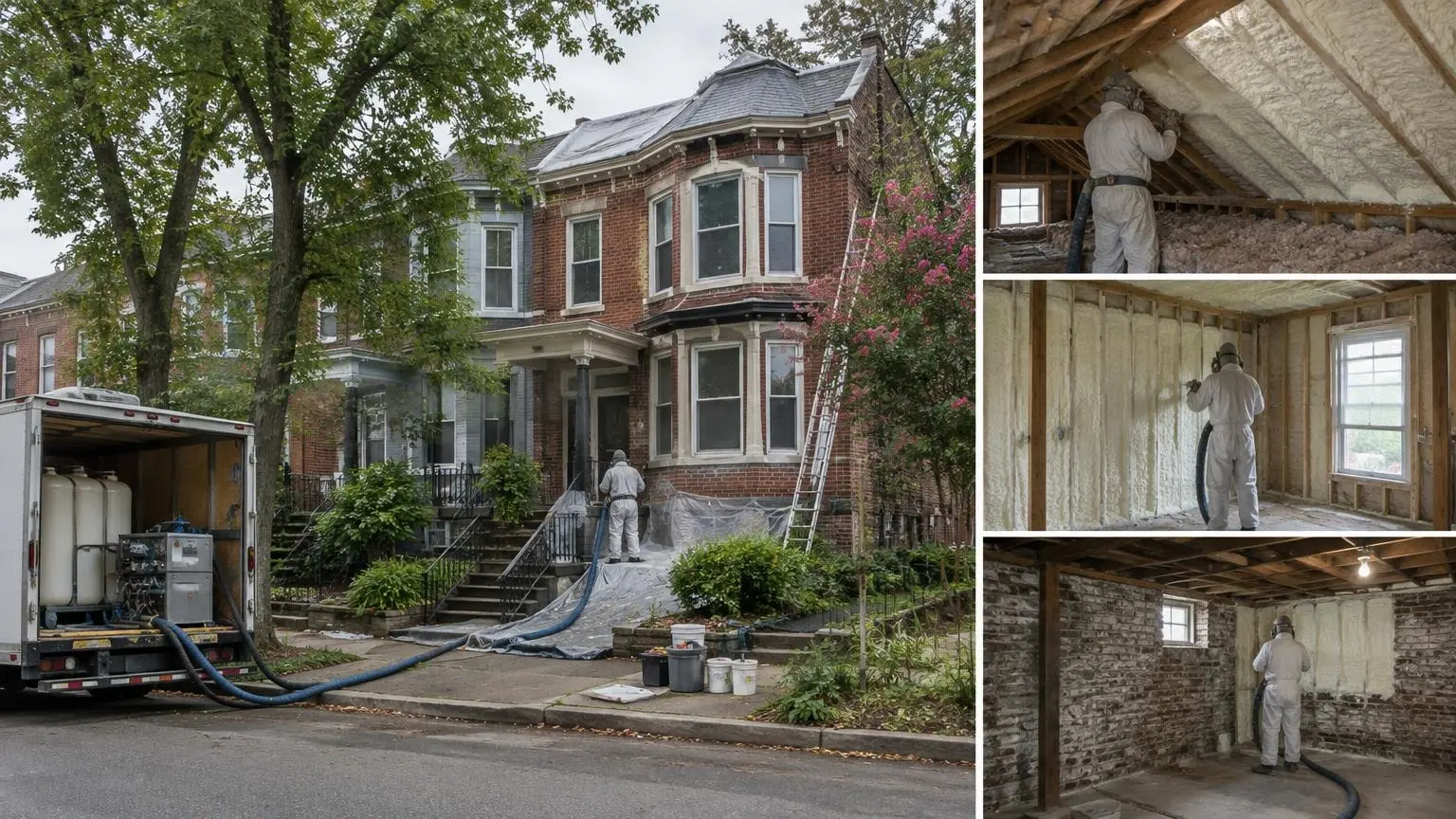
Basement and crawl space insulation in the DC area deals with two problems at once. In winter, cold floors and drafts come up from uninsulated foundations and rim joists. In summer, humid outdoor air gets into basements and vented crawl spaces and meets cooler surfaces, which leads to condensation, musty smells and mold. Sealing and insulating the space below the house addresses both.
Rim joists
The rim joist sits above the foundation wall and leaks air at every seam. Closed-cell foam seals and insulates it in one step. HomeGuide puts rim joist foam at about $2,000 to $2,500.
Basement walls
Rowhouse basements often have old brick foundation walls; suburban houses have block or poured concrete. Closed-cell foam on the inside face insulates and slows vapor, and goes on before framing if you are finishing the space. DC's 2017 IECC-based code lists R-15 continuous, or cavity plus continuous combinations, for basement walls in new work.
Crawl spaces
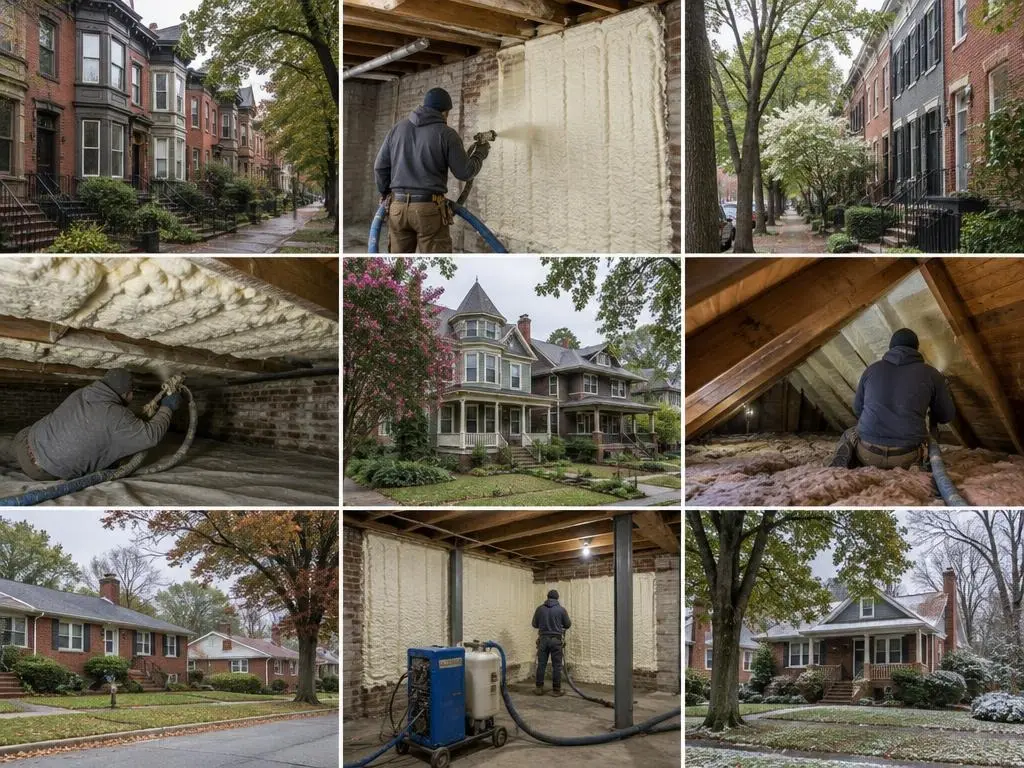
Vented crawl spaces under additions, porches and suburban homes pull in humid summer air. Encapsulation, meaning a ground vapor barrier, sealed vents and insulated walls, turns the crawl space into a drier, semi-conditioned space. HomeGuide lists encapsulation at $3 to $10 per square foot, or $3,000 to $15,000.
Water first
Foam is not waterproofing. If a basement leaks, grading, gutters or drainage need to be fixed first. We check before quoting.
Finishing a rowhouse basement
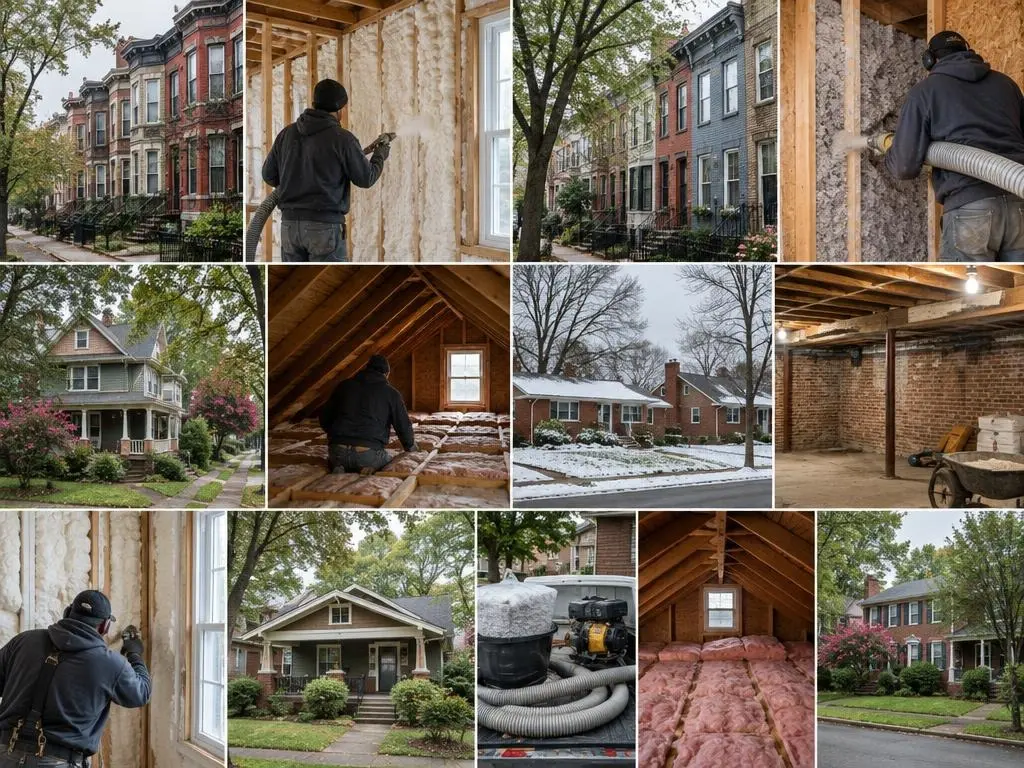
Many DC owners are turning basements into living space or rental units. Foam goes on the rim and walls before framing, and we explain what covering the foam needs. Sealing the basement also cuts musty air that otherwise moves up into the house.
Under rear additions
Rear additions and kitchen bump-outs are often built over shallow crawl spaces or open piers. Closed-cell foam on the underside of the floor seals and insulates in one step. We look at clearance and access first.
What This Covers
The spaces under the house we seal and insulate.
Rim and band joists
Closed-cell sealing the sill and band joist.
Brick, block and concrete walls
Foam on the interior face before finishing.
Crawl space encapsulation
Ground vapor barrier, sealed vents, insulated walls.
Floors over unconditioned space
Foam under additions and bump-outs.
Published Basement & Crawl Space Insulation Costs
| Job | Range and source |
|---|---|
| Rim joists, spray foam | $2,000 to $2,500 (HomeGuide) |
| Closed-cell, installed | $3.00 to $5.00 per sq ft (HomeGuide) |
| Crawl space, spray foam | $2,000 to $4,000 (HomeGuide); $1,000 to $5,900 (Fixr) |
| Closed-cell on crawl space walls | $2 to $5 per sq ft (HomeGuide) |
| Crawl space vapor barrier | $1,200 to $4,000 (HomeGuide) |
| Crawl space encapsulation | $3 to $10 per sq ft, $3,000 to $15,000 (HomeGuide) |
| Crawl space vent sealing | $150 to $450 (HomeGuide) |
Sourced from HomeGuide's 2026 spray foam and crawl space guides and Fixr (2025). Linear feet of rim, wall height, crawl space size, access and prep determine the total. Your written estimate is the price you pay.
How a Basement or Crawl Space Job Goes
1. Check moisture
Look for leaks, efflorescence, humidity and drainage issues.
2. Measure and quote
Rim length, wall area, crawl size and the plan, in writing.
3. Prep
Clear access, protect mechanicals, ventilate.
4. Seal and insulate
Rim, walls, vapor barrier and vents as quoted.
5. Review
Walk through and discuss finishing requirements.
Why Choose Us for Basement & Crawl Space Insulation
Water before foam
We will not foam over a leak.
Clear scope
Every area measured and priced.
Ready to finish
We explain what covering is needed before framing.
Basement & Crawl Space Insulation Questions
Should I encapsulate my crawl space in the DC area?
If it is damp or musty in summer, encapsulation often helps. Sealing the vents and covering the ground keeps humid outdoor air and ground moisture out.
Can you foam an old brick foundation?
Often, if it is dry and sound. We check the mortar and for water before spraying.
Is the rim joist worth doing on its own?
Yes. It is a small area that leaks a lot of air, and sealing it often warms the first floor.
Do I need a dehumidifier after encapsulation?
Some encapsulated crawl spaces need a dehumidifier or a small supply of conditioned air. We discuss it based on your space.
Basement & Crawl Space Insulation Service Areas
- Spray Foam Insulation in Washington, DC
- Spray Foam Insulation in Capitol Hill, DC
- Spray Foam Insulation in Georgetown, DC
- Spray Foam Insulation in Petworth, DC
- Spray Foam Insulation in Silver Spring, MD
- Spray Foam Insulation in Takoma Park, MD
- Spray Foam Insulation in Bethesda, MD
- Spray Foam Insulation in Rockville, MD
- Spray Foam Insulation in Hyattsville, MD
- Spray Foam Insulation in College Park, MD
- Spray Foam Insulation in Bowie, MD
- Spray Foam Insulation in Arlington, VA
- Spray Foam Insulation in Alexandria, VA
- Spray Foam Insulation in Falls Church, VA
- Spray Foam Insulation in McLean, VA
Get a Basement & Crawl Space Insulation Estimate
Tell us about the basement or crawl space. We will check it and quote it in writing.